Planet Visibility Tonight
Real astronomical calculation of which naked-eye planets are above the horizon tonight from your exact location · free, no signup
How Planet Visibility Tonight works, step by step
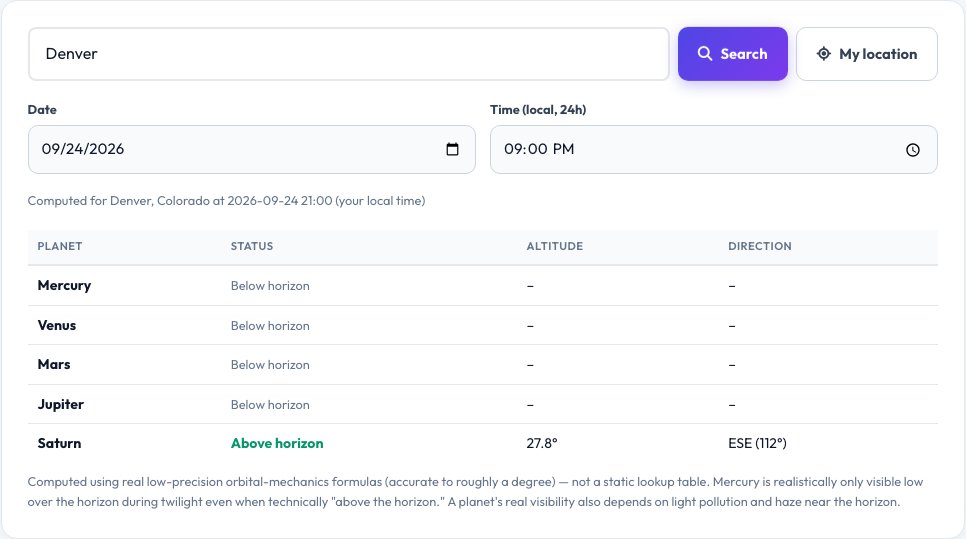
Enter your location (search a city or use your current position).
 Download it
Choose tonight's date and a time to check.
Planet Visibility Tonight
Which planets are actually visible from your exact location tonight is a genuine astronomical calculation that depends on the real date, time and your precise latitude/longitude — not something that can be reliably answered from general knowledge. This tool computes each naked-eye planet's real position using established low-precision planetary orbital elements (the same class of formulas used in classic astronomical almanacs), converts that to real altitude and azimuth for your exact location and the chosen time, and reports whether each planet is genuinely above the horizon.
This is distinct from this site's existing Sunrise, Sunset & Moon Phase tool, which covers the sun and moon only — this tool extends the same kind of real astronomical calculation specifically to the five planets visible to the naked eye, including each one's real computed rise and set time for your location.
Key features
Real orbital-mechanics calculation
Uses genuine low-precision planetary orbital elements to compute each planet's real position, not a static lookup.
All five naked-eye planets
Mercury, Venus, Mars, Jupiter and Saturn, each calculated independently for your exact location and time.
Real altitude, azimuth and rise/set
Shows exactly how high and in which compass direction to look, plus real computed rise and set times.
Distinct from the site's Sun & Moon tool
Purpose-built for the five visible planets, extending the same real astronomical approach to a genuinely different set of bodies.
How to use it
- Enter your location (search a city or use your current position).
- Choose tonight's date and a time to check.
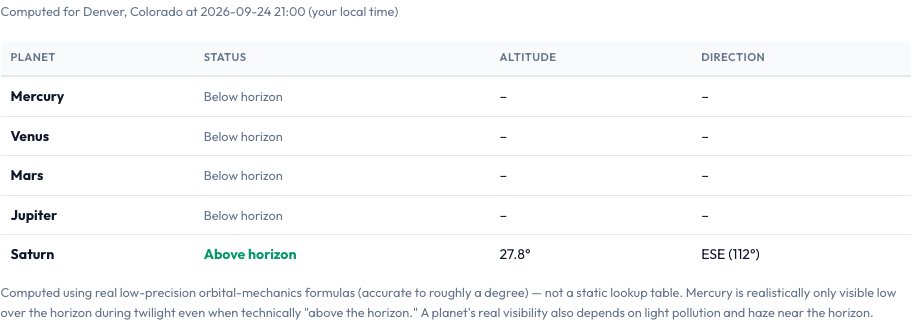
- See each of the five naked-eye planets' real computed altitude and compass direction for that exact moment.
- Check each planet's real computed rise and set time to plan your best viewing window.
Worked example
Example
For a location and a chosen evening time, the tool might compute Jupiter at 34° altitude in the southeast (well above the horizon and worth looking for), while reporting Mercury below the horizon and not yet risen — both real, location- and time-specific results from the same underlying orbital calculation, not a generic 'Jupiter is visible this month' statement.
Who uses this tool
Amateur astronomers and stargazers planning an evening
Know exactly which planets are really above the horizon and where to look, for their specific location and time.
Families introducing kids to the night sky
Get a real, simple answer to 'which planet is that?' before heading outside.
Photographers planning a planet or conjunction shot
Check real rise/set and altitude to plan the shot's timing and direction.
Tips for the best results
- A planet being 'above the horizon' by calculation doesn't guarantee it's easily visible — light pollution, haze, and a low altitude near the horizon all make a planet harder to actually see even when the math says it's up.
- Mercury is the trickiest of the five to actually spot even when technically above the horizon, since it never strays far from the sun and is usually only visible in bright twilight low on the horizon.
- Compass direction (azimuth) is given in real degrees from true north — a phone compass app can help translate that into 'which way to physically face' outside.
Common mistakes to avoid
- Expecting a planet just above the horizon (very low altitude) to be as easy to spot as one high overhead — atmospheric haze near the horizon makes low-altitude objects much harder to see in practice.
- Trying to find Mercury in full darkness — it's realistically only visible during twilight, low over the horizon, near sunrise or sunset.
- Not accounting for local light pollution — even a calculated 'above the horizon' planet can be washed out by city lights, especially fainter ones like Saturn.
Why use AZRS QuickFix?
It is 100% free, needs no signup and has no watermark or usage limits. The tool runs in your browser, so what you type stays on your device, and it works on phones, tablets and desktops. New tools are added every week — bookmark this page or browse the full QuickFix toolbox.
Frequently asked questions
How accurate is this calculation?
It uses established low-precision planetary orbital elements, the same general class of formulas found in classic astronomical almanacs — accurate to roughly a degree or so, which is more than precise enough for real naked-eye stargazing planning, though not observatory-grade telescope pointing precision.
Why only these five planets?
Mercury, Venus, Mars, Jupiter and Saturn are the five planets bright enough to see with the naked eye from Earth; Uranus and Neptune require binoculars or a telescope and aren't included in this naked-eye-focused tool.
How is this different from the Sunrise, Sunset & Moon Phase tool?
That tool calculates the sun and moon only. This tool applies the same real astronomical approach specifically to the five visible planets, each with its own independent orbital calculation, altitude, azimuth and rise/set time.
Does 'above the horizon' guarantee I can actually see it?
Not by itself — real visibility also depends on light pollution, weather/haze and how close to the horizon (versus overhead) the planet is; the tool reports the real geometric calculation, which is the necessary first check before those practical factors.
Can I check a different date, not just tonight?
Yes — choose any date and time, and the same real calculation applies for that specific moment.
Is my data stored?
No, your location and the calculation happen locally in your browser.