Astronomers find three giant black holes in ancient galaxy 12.5 billion light-years away
Astronomers have discovered three massive black holes in a galaxy over 12.5 billion light-years away, revealing that they can coexist and grow rapidly in the early universe. This challenges existing …
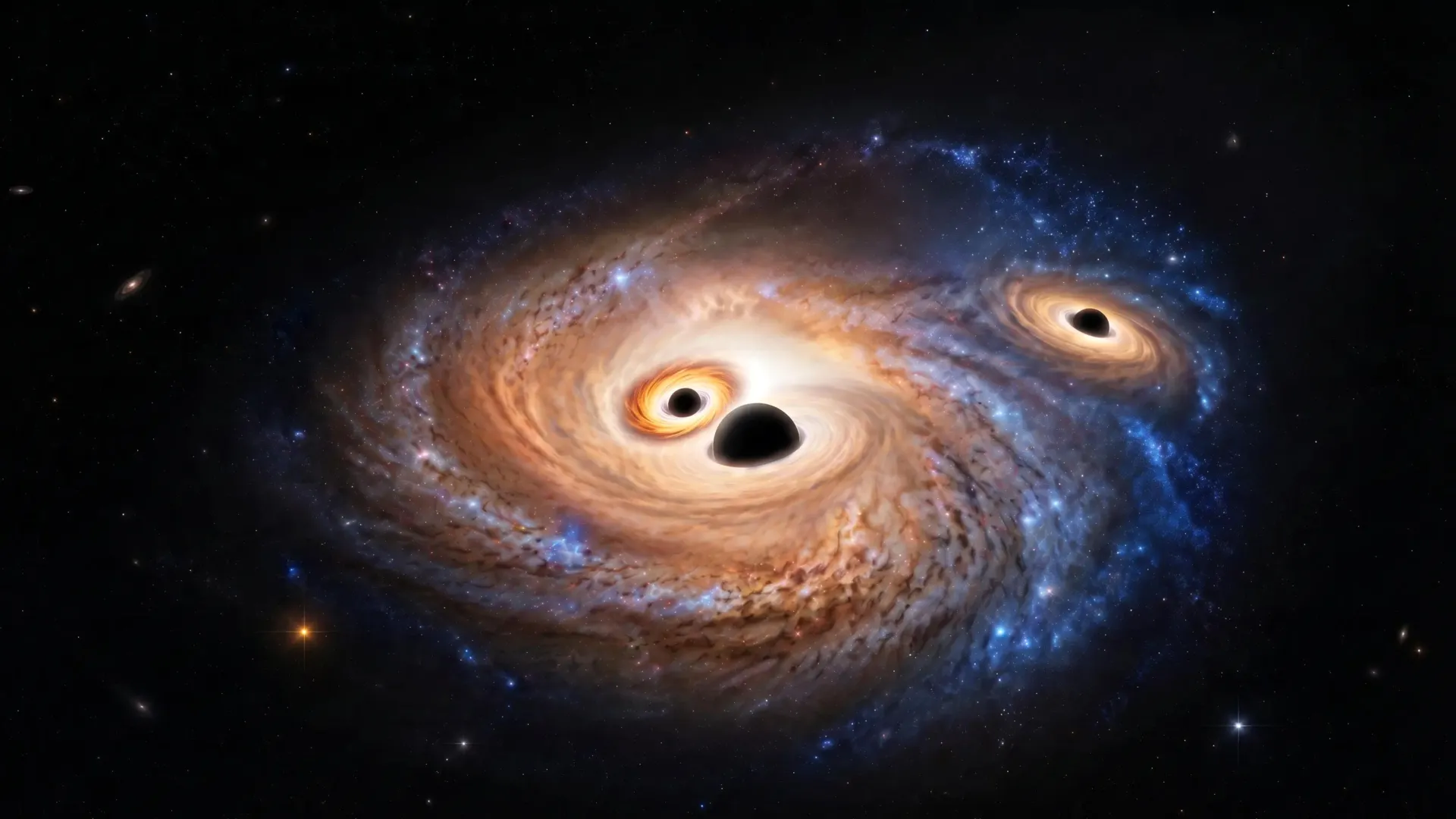
Astronomers have identified three massive, actively feeding black holes within a single galaxy located more than 12.5 billion light-years from Earth. This discovery offers a rare glimpse into the universe’s infancy, a period just a few hundred million years after the Big Bang. The findings challenge existing models of how galactic centers evolve, showing that multiple large black holes can coexist and grow rapidly in close proximity during the early stages of cosmic history. The galaxy itself is a chaotic environment where these gravitational giants are not just present but are actively consuming matter, fueling their immense energy output.
The configuration of these objects is particularly striking. Two of the black holes are separated by a mere 620 light-years, a distance that is cosmically tiny. This close proximity suggests they are on a collision course and are expected to merge in the future. The third black hole is situated farther away from the center, creating a complex triple system. One of these central objects has a mass of approximately 80 million times that of our sun. This is a staggering figure for such an early epoch in the universe’s timeline. It implies that these black holes grew to significant size much faster than standard theoretical predictions would allow.
The rapid growth of one of these black holes is the most puzzling aspect of the discovery. Conventional theories suggest that black holes in the early universe should have had less time and fewer resources to reach such massive scales. Yet, observations indicate that at least one of these objects is accreting matter at a rate that exceeds the theoretical limits of steady growth. This suggests that the environment around these black holes was exceptionally rich in gas and dust. The presence of multiple feeding giants may also indicate a period of intense turbulence, possibly triggered by a recent merger of smaller galaxies that supplied the fuel for this rapid expansion.
These findings have significant implications for our understanding of galaxy formation. They suggest that the centers of young galaxies were far more dynamic and crowded than previously assumed. The eventual merger of the two central black holes will likely release a tremendous amount of energy, potentially reshaping the host galaxy and triggering further star formation or quenching. As telescopes continue to probe deeper into the past, such discoveries are becoming more common. They provide crucial data points that help refine simulations of the early universe. Understanding how these black holes formed and grew so quickly is key to solving the mystery of the first supermassive black holes that appeared in the cosmos.
Read Full Story at ScienceDaily →