'We are on our way to groundbreaking science': Stars turn neon-green in first test image from NASA's Roman telescope — Space photo of the week
What it is: Hundreds of stars, captured in the Nancy Grace Roman Space Telescope's first test image Imagine opening your eyes for the first time and seeing that the sky is full of green doughnuts. …
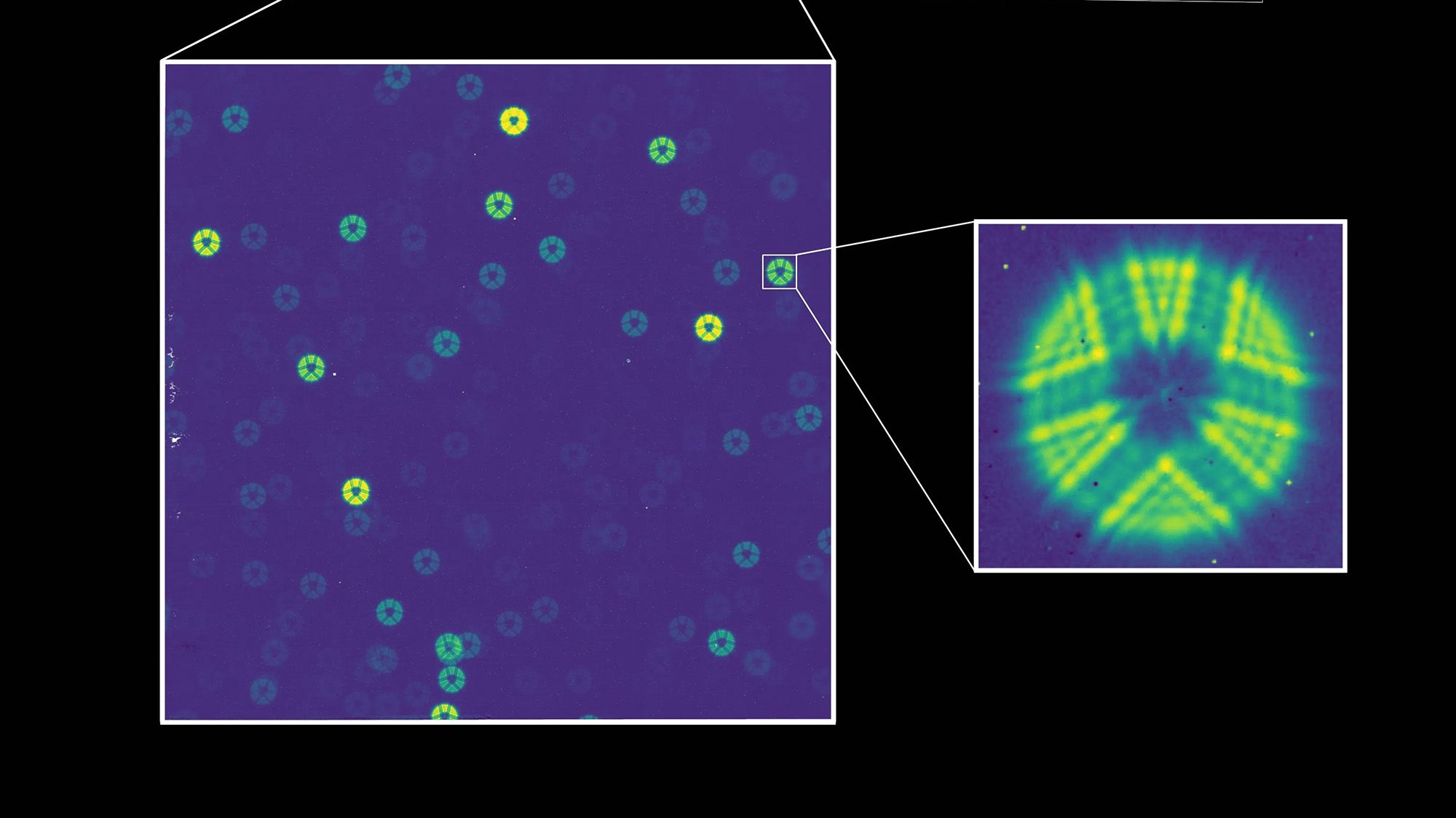
What it is: Hundreds of stars, captured in the Nancy Grace Roman Space Telescope's first test image
Imagine opening your eyes for the first time and seeing that the sky is full of green doughnuts.
This was the view that greeted NASA 's Nancy Grace Roman Space Telescope, which just activated its powerful, 300-megapixel infrared camera for the first time.
The telescope, which launched to space on Aug. 30 , is partway through a months-long commissioning process, with NASA scientists testing and tuning each of the spacecraft's instruments as it undertakes a million-mile (1.6 million kilometers) journey to Lagrange point L2 — an orbital "parking spot" where the competing gravity of Earth and the sun will hold Roman in place, alongside the James Webb Space Telescope ( JWST ) and other scientific spacecraft.
Roman's camera system, known as the Wide Field Instrument (WFI), hasn't been fully focused yet, so the stars look like lime-colored loops in this debut test image. But so far, all systems are working as they should, according to a NASA statement .
By the time Roman is ready to beam home its first full science images in early 2027, it will be capturing cosmic snapshots as crisp and detailed as those from the Hubble Space Telescope — but each of Roman's images will cover an area 100 times larger than Hubble's.
"After years of effort to build and test the instrument on the ground, we now have confirmation that it is operational in space. This is a huge milestone," Josh Schlieder , chief WFI scientist at NASA's Goddard Space Flight Center in Maryland, said in the statement. "There is much to do, but we are on our way to groundbreaking science."
The wavy rows of squares in the new image are key to Roman's photo-taking power. Each square represents one of Roman's 18 detectors, which translate photons from distant light sources into electrical signals that encode enormous images of the universe. Scientists are preparing for the telescope to beam roughly 1.4 terabytes of data — about five to 10 times the storage capacity of an average smartphone — back to Earth every day.
Read Full Story at Live Science →